The Ridgeway National Trail is an off-road trail in south central England. Earlier this year, a few friends and I cycled the route (in both directions) over three days. I thought it would be a good idea to post my reflections on the route and provide (I hope) some useful tips if you are planning to do the same.
- Distance: 87 miles (official route).
- Start: Overton Hill (near Avebury) in Wiltshire.
- End: Ivinghoe Beacon (near Tring) in Buckinghamshire.
- Terrain: Mainly off-road, chalk downlands and forested bridleways but with some quiet lanes.
Firstly, there is lots of useful information about the Ridgeway Trail on the National Trails website. That’s the best place to start when planning your trip. Also, Wikipedia has a section about the Ridgeway.
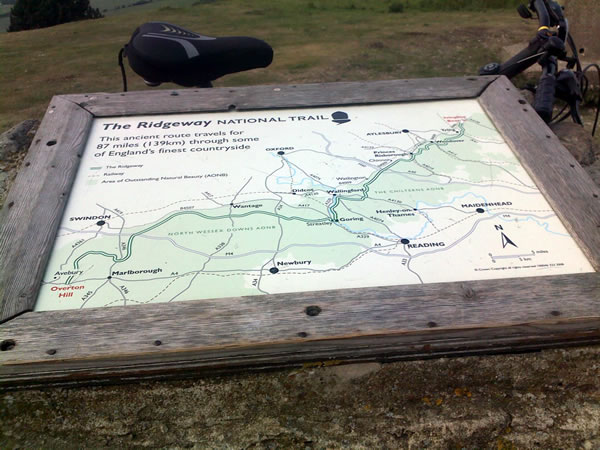
Our Route Itinerary
We decided to cycle the trail in both directions (from west to east and back), partly because it’s pretty difficult to organise a way of getting from the end of the route back to the beginning again (even with cars), and also because we had three days to do the route. So here’s what we did:
- Day 1: From Marlborough, cycle 4.5 miles to the start at Overton Hill, then cycle the Ridgeway mostly off-road to Stokenchurch (via Streatley and Goring-on-Thames) – total 68 miles
- Day 2: From Stokenchurch to the Ridgeway Trail endpoint at Ivinghoe Beacon (via Tring) and back to Stokenchurch – total 54 miles
- Day 3: Cycle Stokenchurch to Marlborough – total 60 miles (off-road) or 52 miles (by road)
Our route was determined by where we were staying but the overall distance may well be be similar even if you stay in slightly different places.
You definitely will find it easier with Ordnance Survey maps for this route. The maps are Landranger 173, 174, 175 and 165 although 173 only covers a small section at the start. Sustrans also has a map of the Ridgeway.
Where We Stayed
We stayed in the Ivy House Hotel in Marlborough and the King’s Hotel in Stokenchurch, both of which were fine. However, the Stokenchurch hotel is opposite a pub and, with the windows open on a summer evening and late night pub opening on Friday and Saturday, it can be pretty noisy if you in are rooms at the front of the hotel.
In Stokenchurch, we ate a meal at another pub called the Royal Oak (with great Thai cuisine) behind the hotel. In Marlborough, there are pubs and restaurants up and down the wide High Street.
Both hotels provided areas to store bikes, either in a locked room inside, or at the rear in a quiet car park.
Cycling from Marlborough
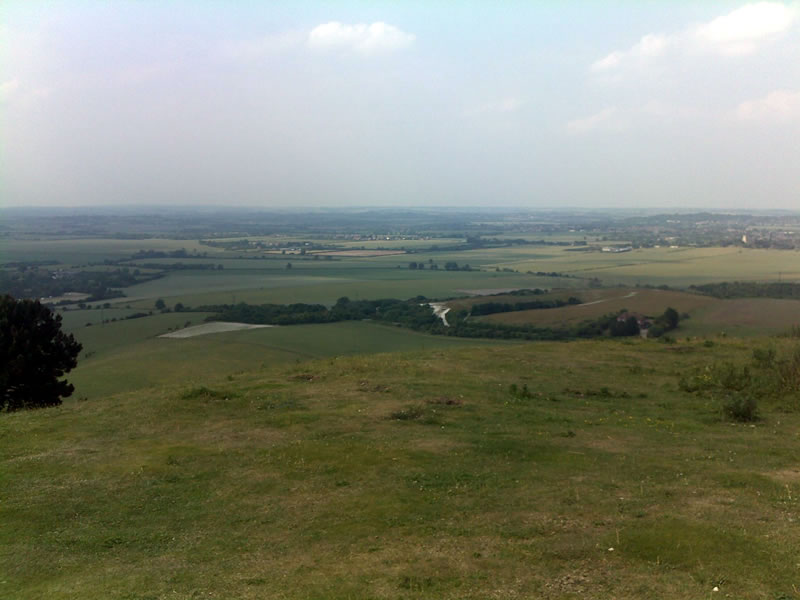
The first day was mostly off-road over chalk downland and it can be hard physically if you are not used to this. There were some sections that I found quite difficult technically because they were rutted and there were a few tough climbs. However, in the main it was very pleasant open landscape riding with some fantastic views from the Ridgeway over the surrounding countryside.
Like any long distance cycling trip, you should take plenty of water, energy drinks and food with you (for advice about how to carry this, see also Rucksack or Bike Bag?). Be aware that unless you go off-route to visit nearby villages, there were not many obvious food and drink stops for long sections of this first part of the route. However, there are water stand pipes at some points and these were very welcome!
- Tip: Even if you still have water, drinks and food in your bag or rucksack, take every opportunity to top-up when you reach shops. You’ll not always know when the next replenishment stop will be.
This section of the trail was well signposted and we had no major problems finding our way on the off-road sections. However, after Streatley and Goring-on-Thames, the Ridgeway is a footpath in many places so you’ll need to find alternative bridleways. We used the Swan’s Way for part of this latter section until Stokenchurch. If by any chance you are staying in Stokenchurch, there is a long climb on the A40 for the last few miles (north of Stokenchurch travelling south). Just what you don’t need at the end of a long day!
To Ivinghoe Beacon
The second day was quite a contrast to the first because the bridleways were mostly forested and because we had quite a bit of difficulty finding the way. As mentioned previously, the Ridgway is mostly footpath in this area so we had to find alternative, mostly parallel-to-the Ridgeway, bridleways that allowed cycling. We spent a lot of time looking at OS maps! We followed the Swan’s and Icknield Ways (I think) and also cycled some quiet country roads before we reached the end of the Ridgeway at Ivinghoe Beacon. The last part of the route was a deceptively long, slow climb from Aldbury to Ivinghoe and the Beacon. The last section is a path up to the Beacon itself. It was a great feeling at the top!
To be honest, we arrived at the Beacon between 3 and 4 pm which was much later than we’d planned. If you get there at a similar time and you need to get to your hotel quickly, take my advice and take a faster road route after the Beacon. That’s what we did to get back to Stokenchurch.
- Tip: Even though it might be tempting to get up late on each day of a cycling trip, my advice is to get going as early as possible. You can often cover a few miles on quieter roads at the start and you’ll finish earlier – giving you more time to relax in the evening.
Back to Marlborough
For the final day, we cycled back to Marlborough via one of two routes. Either off-road using the same route in reverse or by road via Watlington, Wallingford, Didcot, Wantage, Bishopstone and the A346 to Marlborough. I did the road route because by that point I really needed to make sure that I got back at a reasonable time (and because I wanted to watch the England v Germany World Cup game that afternoon). There were no real problems with the road route and much of it was on quiet roads. However, the A346 into Marlborough is a busy road (and it has a tough little hill near the end).
Boy, oh boy, it was good to relax back in Marlborough that evening (despite the football result).
- Tip: It’s not always possible but try and cycle in groups (or pair up) on long distance trips. It’s safer if you have a fall and it’s a lot easier to repair punctures and/or change tyres with moral support from friends – and you’ll have a wider range of bicycle tools to call on as well.
In Summary
You have to be physically fit to cycle the Ridgeway so it’s not for mountain biking beginners. Some of the terrain is very similar to the South Downs Way but I found the route (slightly) easier because there are less hills. The first part of the route has some fantastic open downland, chalk ridge cycling and that was the best bit for me. I would say that the Ridgeway is not too difficult in a technical sense but you need to start early and allow enough time on each day to cover the distances.
Overall, I think we all enjoyed the three days even though it was pretty demanding.
If you are thinking about cycling the Ridgeway Trail and want to ask any questions about the route, leave a comment below and I’ll try to answer.
- Update: This article describes my first trip cycling the Ridgeway and I cycled the Ridgeway Trail again in 2014.
Clive, we are planning a bike trip along the Ridgeway, from Stokenchurch to Avebury, kipping overnight there and cycling back – on mountain bikes. I’ve been ‘roped’ in, so not sure on details yet, but I clearly see that the track will be hellish in the wet and therefore best avoided on bikes. Our party will be 2 adults and a group of 13 yr old boys.
Thoughts on likelihood of this being achieved – I’m sceptical until I know more.
Thanks, David.
David, it depends on your cycling experience and fitness but I think that will be pretty tough for the boys (at the very least). The Stokenchurch to Avebury section of the Ridgeway is mostly off-road, chalk downs riding and the distance is likely to be 60 – 65 miles each way. The road route is easier but not a huge difference in distance. Either way, I suggest that you need to be able to ride a 40-50 mile trip on road, without major problems, before tackling this.
The Ridgeway is best done in the summer because, as you say, wet conditions will add another level of difficulty.
Hope this helps. What’s the cycling experience of your group?
Clive, I cycled (a lot but not all) the South Downs Way last year with a small group, from Eastbourne, aiming for Winchester but only managed as far as Petersfield. We are cycling the Ridgeway from Marlborough ending somewhere near Tring (being arranged by a friend) this coming Friday over two days. I wondered if you’ve cycled the South Downs Way and can give your opinion about how hard the Ridgeway is in comparison. Thanks, Gary
Hi Gary, yes I cycled the South Downs Way from Winchester to Eastbourne (over three days) a couple of years ago. I found the SDW more difficult physically than the Ridgeway although some aspects of the terrain are very similar (chalk downland). When I cycled the SDW, I had not done many 2-3 day rides so I was probably not as prepared as now. However, the SDW has a lot more climbs, and they are harder/closer together, than the Ridgeway. There are some climbs/descents on the Ridgeway but they are a lot more spaced out. You still have to cover the miles though.
Some sections (not many) of the Ridgeway were rutted and they were the most difficult bits technically. There were a couple of downhill singletrack sections on the second day (before Tring) which needed concentration but we did get a bit lost that day so you might not see these.
Overall, I’d say the Ridgeway is not as tough as the SDW. If you can get to Ivinghoe Beacon, the end of the Ridgeway near Tring, the views are well worth it from the top. Good luck!
Hello Clive – I note you did the 87 miles in three days. How far did you go per day? I am used to riding that sort of distance on my road bike in a single day so was hoping TWO days for the Ridgeway wasn’t unreasonable… but I have no concept of how far one can go off road in what, 7 hours?
Also, it is my good fortune to live within easy cycling distance of Tring, but how would one get to/from the western end by public transport?
Thanks,
Andrew
Andrew, I cycled the Ridgeway in both directions over three days. Details of each day’s distances are in the Itinerary section of the article. In my experience, 50-60 miles off-road is equivalent to 90-100 miles on-road but this is only an approximation since it will be heavily dependent on the terrain. Whilst the Ridgeway is not the most demanding off-road route I’ve done, it is still a reasonable distance each day. We finished riding each day at approx 6.30 pm although the last day was shorter than that. For 7 hours off-road riding, I’d allow 8-9 mph average so that means 50-60 miles. You will also need to add time for stops to this as well. Hope this helps but it is also dependent on weather and your fitness and experience.
Hmm… thanks for that! What train stations are convenient for the most westerly point?
Andrew, I don’t know the train connections very well I’m afraid. Swindon definitely has a station. Chippenham or Marlborough perhaps?
Hi there we are staying just north of Goring on Thurs night and want to cycle part of the Ridgeway Fri. Prob is my husband is a keen hill climber and I am far less ambitious. Where’s the best place to cycle bearing in mind that I am not keen on hills or disputes on shared bike rides. My husband will just be glad that I’m sharing his hobby with him.
Thanks
Jann
Hi Jann, the Ridgeway is a mixture of terrain and it depends if you are cycling east or west from Goring so it’s a bit difficult to be exact. There are some hills but also a lot of downland riding along the top towards Marlborough. Check the Ordnance Survey maps beforehand because they give a good indication of hills and terrain.
Good luck and have a great ride!
Hi Clive, Is a regular road bike suitable for the section from Overton Hill to Goring, which appears to me to be a clearly marked out trail on the map. I can see that the section north of Goring is probably un-suitable from your description, so I am wondering if this western part is accessible by a non-mountain bike. Thanks Oliver
Hi Oliver, there are some sections of the western half of the Ridgeway that you can cycle with a road bike because parts of the trail are wide and the surface is rather like an unmade road. However, I don’t recommend a road bike because there were some bits that were narrow, rutted, rocky, and just plain tough to climb/descend. I don’t ride a road bike myself so I don’t know how far you can push the bike in a technical sense. I wouldn’t want to cycle the Ridgeway on a road bike though.
On the official trail guide website, they say “the western section is a marvellous route for mountain bikers (those using touring bikes might struggle a bit)…”
Thanks for the information Clive
Hi Clive. Just found this article on Google. Thinking of doing the Ridgeway this spring, from the east to west as we are near Ivinghoe Beacon. How much of it will need to be on road because of footpaths etc…
Hi Nigel, between Ivinghoe Beacon and Stokenchurch, we had some trouble picking up bridleways, and we had to circumvent footpaths as well, so I reckon we did about a third of this section on road. However, for the section after that, between Stokenchurch and Avebury, it was 90% off-road bridleway. That was the best bit for me. Have a great trip!
Hi Clive, I am planning on doing the full Ridgeway route in 1 day, do you think it’s possible? I can normally do 40 miles in about 4 hours.
Jase: It’s doable but will be a really tough and long day. I don’t know your level of fitness but I wouldn’t want to do it in a single day. I say this because I’ve done the western section (to Avebury) and back to a starting point near the middle. That was 75 miles off-road and very tough.
Hello
I read your article with interest as I’m planning to ride the ridgeway route – but with a horse rather than on a bike. Bit of a difference I know but as cyclists and riders are both restricted to bridleways/roads it’s still interesting to me!
What I was wondering is how you accessed Ivinghoe Beacon? Although I know I’m going to have to deviate from the proper ridgeway for the footpath sections, I would really like to start at the ‘proper’ start (or finish for others!).
Many thanks
Hi Claire. The final section to Ivinghoe Beacon was a footpath so we walked the bikes there from the road. You’ll need to walk with your horse, or tie-up near the road and walk, if you want to get to the very last point or start from there. It’s a great view from there though so it’s worth it! Good luck on your trip, hope it goes well.
Hi Clive
I am planning to cycle off road from sussex to wales. The first part will be south downs way to Winchester. Would you know any off road routes to wales from winchester?
Hi Mark, I don’t have any experience of off-road routes in that direction. Check out the Sustrans website because they will have maps of National Cycle Network Routes. These are on road, I know, but they might give you another option. Route 24 might be one to check because it goes from near Winchester to Bath area. I know that there is a cycle path from Bath to Bristol. Not exactly off-road but it’s car-free.
Hope you can find a decent route. Good luck with the trip!
My son, my six year old grandson and myself would like to sample a section of the Ridgeway on our bikes. It would be our first experience of it. Can you recommend or suggest an easy going section that might be suitable for first timers? A stretch of up to thirty miles would suffice and could include an overnight stop. Views over open country and big skies preferred to woodland. Are mountain bikes a “must”?
David
Hi David, I recommend mountain bikes, yes. But you can get away with hybrid bikes on some sections. The section south of Wantage and Didcot has some good views. That distance and the overall surface of the Ridgeway sounds tough for a six year old though. It would be best to check it out before you ride it, I’d say.
There seem to be mixed views about using hybrid bikes or tourers. For the first section only, from Overton Hill to Streatley, would non-mountain bikes be viable?
Based on my experience, I would say not for the very first section near Overton. That first section was quite rutted when I cycled it. Of course, it may have had surface improvements since then so perhaps you could check it out beforehand? Some sections after that were also quite tough on the bike.
Hi Clive, very useful notes thank you. After reading through them a couple of times two of us cycled the full Ridgeway from West to East on Friday. We couldn’t have chosen better weather, cloudy but not too cold, no rain and light wind right on our backs. Conditions on the trail were excellent for the most part with little mud and standing water and very few other trail users. Total elapsed time was almost exactly 12 hours with an average riding speed of 9.3mph. We’d definitely recommend this as a challenging one day ride. Care needs to be taken on timing the trip as only a couple of days earlier large sections of the trail had turned into chalk/mud gloop from a few days rain. Fortunately this can drain away and the trail dries out quickly but we couldn’t have completed the ride in a single day we hadn’t had the 48 hours break since the last rain. We both used mountain bikes, I would think it very difficult to complete the trail using any other type of bike.
Hi Neil. Thanks for your comment. Sounds like you had a great ride. Nice one!
Hi Neil
I am planning to cycle the full distance in July with some friends. My understanding is it is not possible to cycle some of the most easterly parts. Can you advise on what tracks or roads you used and how they were? We will be using mountain bikes (of course!).
Nigel
Your correct that the Western [this should be Eastern: Clive] part contains more footpath sections but a short time with a map will find a suitable route around these sections and in the end we travelled 86.3 miles against the official version of 87 miles.
Here’s what we did;
Ridgeway from Overton Hill (start) to Goring (halfway). Then a slight detour in Goring where the Ridgeway follows a footpath for about 100 yards and then back on the Ridgeway to South Stoke. From here we followed the Swan’s way to a point between Britwell Salome and Watlington where it rejoins the Ridgeway. You’re following a course quite close to the Ridgeway and a lot of it is off-road and some very minor roads so it didn’t feel like cheating. We found The Swan’s way very poorly marked (complete lack of signposts really) so a map was essential. From Watlington we followed the Ridgeway to a point south east of Princes Risborough where we picked up the Icknield way trail to the outskirts of Princes Risborough where we met the Ridgeway again. (Technically you’re following the Icknield way from just outside South Stoke, but as this is a Ridgeway ride and there are no Icknied Way signposts I’ve described it in terms of the Ridgeway). From Princes Risborough you only follow the Ridgeway for a short distance before continuing to Whiteleaf and Askett when the Ridgeway footpath heads off up the hill to the right. When you meet the A4010 it’s a sharp right up a bridleway that skirts Pulpit Hill and brings you out at the front entrance to Chequers (where you meet the Ridgeway proper again). From there you can follow the Ridgeway all the way up Coombe Hill, through Wendover and on to the top of Wendover woods. Technically there is no Bridleway to the monument on Coombe hill but it’s a wide open area and there are always bikes cutting across the grass here. For us it was the best view of the whole ride so worth it.
At the back of Wendover Woods there’s a slight detour on a minor road and bridleway to avoid Chivery hall farm and then back on the Ridgeway through Tring park to Wiggington. Now you have an option as you can’t take the footpath over the A41 bridge, left to Tring station or right through Aldbury to Tring station. Here you pick up the Ridgeway again and follow it all the way up Pitstone Hill. The Bridleway deviates from the path in the woods by a few yards but on the ground it’s difficult to differentiate between the two. From Pitstone hill it’s technically a footpath all the way to Ivinghoe beacon but I live in this area and it is constantly being ridden by mountain bikes. If you’re courteous and give way to walkers there shouldn’t be a problem but you could follow minor roads to the bottom of the beacon. Once you’re here the last climb is too steep to ride (especially after 86 miles) so you’ll be a pedestrian pushing a bike anyway.
Once we planned our detours around the footpath sections we didn’t have any problems, the under-wheel conditions are exactly the same as on the Ridgeway bridleway sections and we managed to restrict the amount of time on roads.
We used the Ridgeway XT40 route map, it gets the whole route on one map, is printed on waterproof plastic and covers enough detail either side of the route to find suitable drop-out points and food/accommodation. It’s 1:40,000 scale but pretty close in detail to the OS Explorer maps.
Hope this helps
Thanks Neil appreciate that.
Thanks Clive, very useful page.
A lot of people asking how to ride the Ridgeway NE of Goring get very vague answers from internet pundits. I’ll try to be precise if I can:
Use an OS map. Follow Swan’s Way from Goring to Wain Hill (SP 770 011, east of Chinnor). There switch to Icknield Way Trail, which takes you all the way to the Pitstone Hill car park near Ivinghoe Beacon. From there it’s a chalky, rideable footpath up to Ivinghoe Beacon. You’re not supposed to cycle on it but people do. Or just push your bike and walk.
Note: You need a map. The Swan’s Way is clearly marked on OS maps but the Icknield Way Trail is only patchily marked. I recommend you visit the LDWA’s webpage on the Icknield Way Trail, which has a very detailed zoomed-in map of the route. Mark this route on your OS map with a highlighter pen or whatever – especially all the junctions and changes of direction. If you just rely on the bare OS map there are quite a few places where you could easily go astray.
Enjoy!
Many thanks! Useful information for everyone.